I am a writer, poet, teacher who loves the natural world, photographing insects, and spending times with dogs. You can see some of my photos of insects on bugguide.net and my writing and photos of insects and dogs on my blog and my Substack newsletter. I'd rather laugh than not, and rather dance than almost anything else.
What do the Swallowtail Butterflies, Bumble Bee Queens, and Fireflies have in common? They all depend on leaf litter as their home and protection during our winter months. For the last ten years there has been a growing movement to get people to leave the leaves in their yard in the fall to benefit wildlife. But the reasons are just as compelling to put off removing leaves in the spring.
As long ago as 2015, the National Wildlife Federation was advocating for leaving fall leaves, and the Xerces Society and others have taken up the call. And, somewhere along the line October was declared as “Leave the Leaves” month. To the extent that folks followed that advice, all sorts of critters have benefited. The bumble bee queens that burrow shallowly in the soil under a protecting layer of leaves, the adult Mourning Cloak Butterflies that tucked into the leaves, and the stick insect eggs that dropped from the tree or shrub on to the leaf litter all had better chances of surviving the winter.
But for over ten years, a crucial element in backyard habitat protection has been ignored. Simply put, the leaf litter layer is like Nature’s winter coat for those creatures. And just like we don’t put our own winter coats away when we get the first sporadic, warm, sunny days, if we want to protect pollinating insects and those that will feed the birds who depend on them for food to raise their young, we should leave their winter coat in place, too. The temperatures will dip again and the insects will need the protection.
It can be satisfying to clean up the yard and fill leaf bags with the refuse, and I’ve certainly filled my share of them, but I’ve learned the bags contain not only leaves and twigs, but insects at all stages of life: egg, larva, pupa, and adult. Many of them are small and even if visible, not recognizable because they look starkly different than the adults. And some are disguised, like the Swallowtail Butterfly pupae that mimics fallen leaves.
I understand the urge to do something, anything, to make the early spring yard look better. But if you’re hoping to support pollinators, and the birds who rely on insects to raise their young, April is too soon. Clear walkways to keep them safe, of course, but leaving the leaves this spring will help out not just the birds and the bees, but the butterflies, moths, and fireflies.
To start, a couple of reviews of insect books I recommend, then on to my yellow jacket summer.
Jill McDonald’s Exploring Insects, a book for children,is a beautiful introduction to the world of insects and critters we mistake for insects. The illustrations are attractive, McDonald uses simple language to define well-selected vocabulary, and each page offers a question that invites reflection and encourages curiosity and conversation.
Eric R. Eaton’s Wasps, The Astonishing Diversity of a Misunderstood Insect, is itself astonishing. The illustrations and photographs are worth the price of admission. I hadn’t seen this book when I ordered it through Bookshop, and I’m really struck by its quality. If you know anyone who likes wasps, you know someone who will love this book.
And our own experience with wasps: this past summer, our yard hosted Ground Yellowjackets in the front yard and Umbrella Wasps near the back door. The nest locations were a little inconvenient.
Eastern Yellowjacket and Viburnam
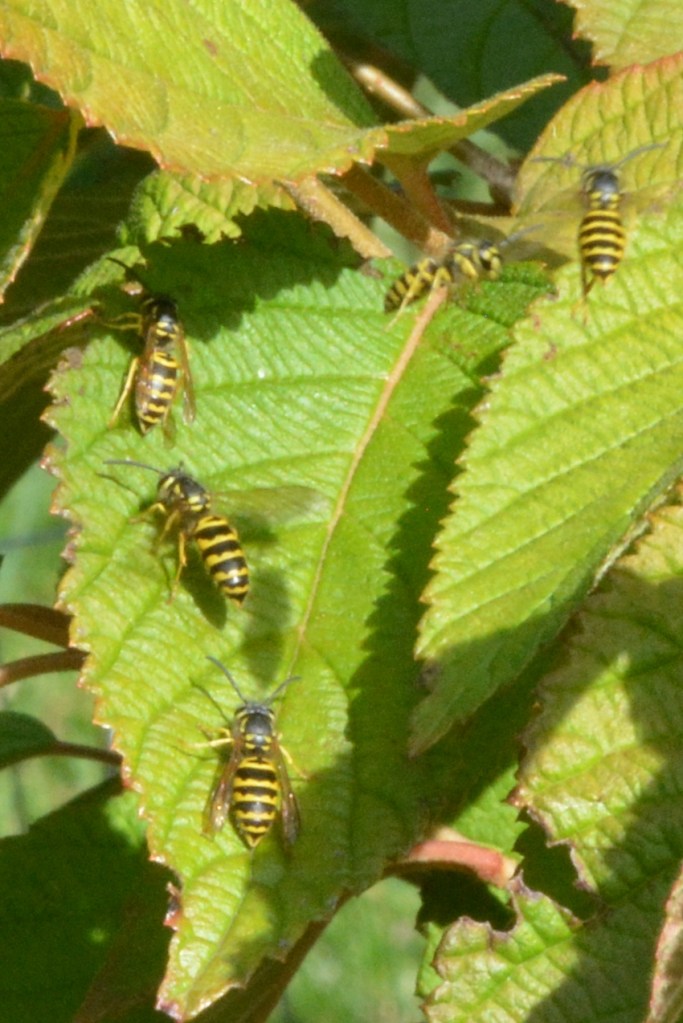
One mid-morning this summer I was weeding by the viburnum in the front yard and found the air filling with yellow and black insects. I backed away slowly. After a few hours, when they were visible but not agitated, I slowly and quietly returned to retrieve my garden tools and camera, and saw I’d been working inches from the Yellowjackets’ ground nest. I ceded the area to them for the rest of the summer.
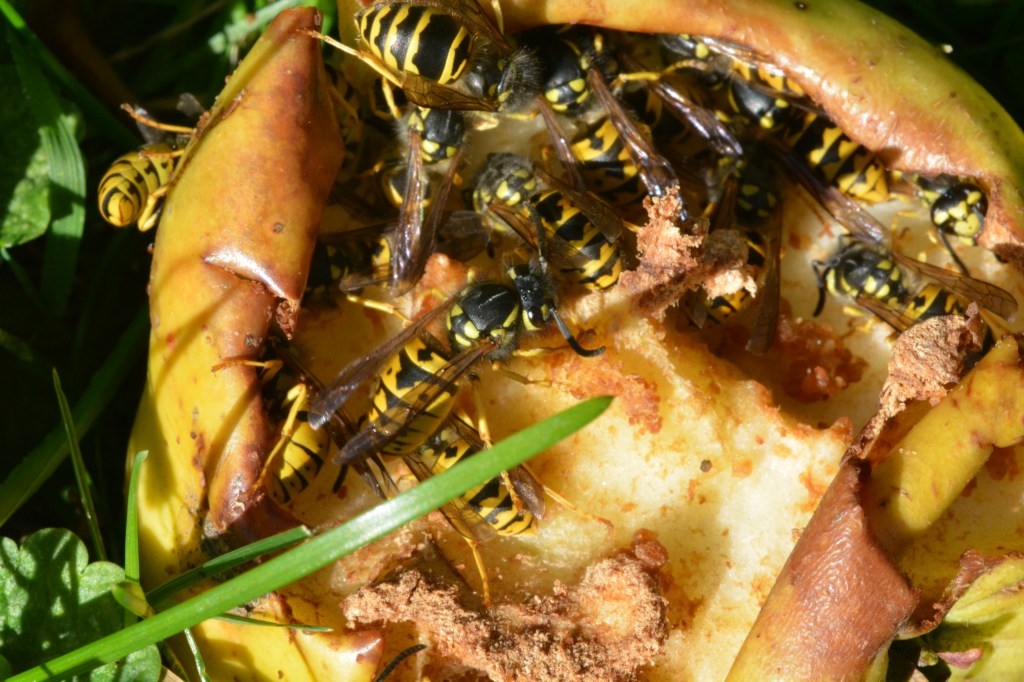
With the help of iNaturalist and Bugguide.net, I identified them as Vespula maculifrons, a Ground Yellowjacket also known as the Eastern Yellowjacket. According to Bugguide, they are the most abundant Yellowjacket species east of the Great Plains. The adults feed on nectar and the juice of ripe and rotting fruit. As it happens, I first identified this species years ago when I rented a house with a big apple tree in the backyard and couldn’t keep up with the fallen apples. Yellowjackets of several species appreciated the bounty, including Vespula germanica, the German Yellowjacket, just left of center in this photo.
Meanwhile, in the backyard this summer, wasps nested: European Paper Wasps,Polistesdominula. Oddly enough, in a bluebird-shaped birdhouse that I’d left on the back deck.
I’ve been familiar with Paper Wasp nests under eaves, but this hidden-cavity nesting is new to me; according to information on Bugguide.net, cavity nesting in wasps is species-specific. Paper wasps in general are less territorial about their nests than Yellowjackets, and they didn’t do anything startling, but I didn’t linger on the deck once they’d taken up residence.
I waited till after a deep frost to bring the birdhouse inside to try to get a photo of the nest. It was tucked up on the right side of the “ceiling.” Note the empty cells.
The cavity nest of Polistesdominula
The members of the genus Polistes are also known as Umbrella Paper Wasps, a name I find charming without knowing why. Polistes means “founder of a city,” although since it is a fertilized female, a queen, who selects the site, builds the nest, and establishes the colony, you’ll see writers refer to the “foundress of the city.”
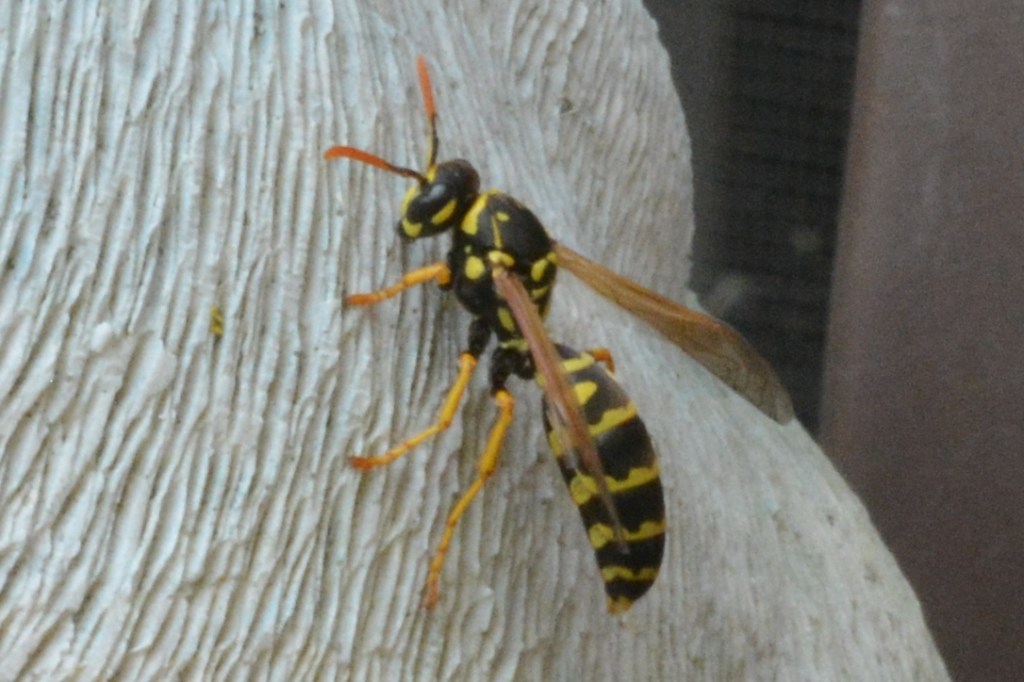
These flyers with their vibrant orange antennae, (a key identifier for Polistesdominula, by the way), were interesting company this summer – once, when I inadvertently moved the birdhouse a few inches, they couldn’t find the opening even though they flew directly over it. It took a couple of tries for me to get the birdhouse back to where they could find their way in. When I set up my tripod to try to get better photos, I captured this behavior:
The yellow-faced male coming in for a landing.The curly antennae are another distinguishing feature of the male.It’s easy to see why these wasps can be mistaken for Yellowjackets.
Here in northern New York, November has been cold and, with the exception of the new queens, this year’s colonies will have died off. The new queens have left the nest and are overwintering somewhere, maybe in leaf litter, or logs, or soil. But what about next summer? It’s impossible to predict exactly where those queens will choose to start their colonies.
Even though I could, I wouldn’t do anything to discourage the Eastern Yellowjackets. I’m in the habit of leaving areas of bare ground for the ground dwelling bees, and if the wasps take advantage of them, that’s fine. I wasn’t stung or even harassed by these insects, despite them being disturbed by my pulling weeds inches from their nest entrance. The next day when I went out to photograph them, they were already out and flying; I kept my distance and they ignored me.
But one summer of close observation of wasps on my back deck was enough: I don’t think the wasps would use the birdhouse again, but I’ll move it to the wooded area behind the house where anyone, from mice to bluebirds to wasps, will be welcome to it.
Wasp-watching is done for the year and the process of going through photos I haven’t had a chance to review is underway. And, reading and researching continues on, of course. Here are two books I’m pretty excited about, with Bookshop links:
When I began my blog, it was heavily weighted on insects and the natural world. As I began to be more involved at the local animal shelter, the blog reflected that shift. I’ve recently stepped back from training shelter dogs and have carved out more time for writing, and for photographing and identifying the insects and spiders in my backyard. Of course, I still love dogs and will always treasure them in my life, but I’m glad to have renewed my focus on writing and on the world of bugs.
One result of that renewal is that on October 1, 2025, 6:00 PM – 7:30 PM, I’ll be offering a presentation at the St. Lawrence County Cornell Cooperative Extension Farm in Canton, New York, to share what I’ve learned over more then ten years photographing and identifying insects in whatever place was my backyard at the moment. From three country acres in Canton, NY to a little apartment in the village of Potsdam, to a small house in Canton, and then finally back to a house in the village of Potsdam where I’ve lived since July 2020, I’ve been documenting the insects I find in my yard. With over a hundred species and counting, I have a wealth of photos to share and hints to offer. This project has enriched my life and I’m eager to meet folks who share my interest in backyard critters. For more information about the presentation, here’s a link: Hello, Insects! Field notes from a local backyard
It has been an incredible summer in my backyard, with Thistle proving to be a big hit with many species.
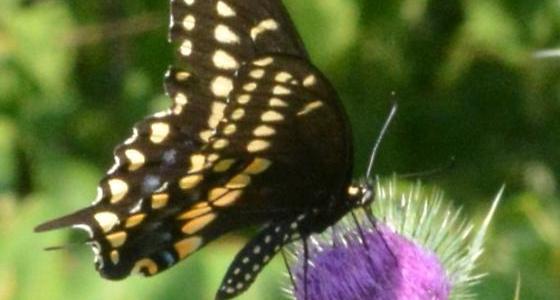
For several days, a Black Swallowtail, Papiliopolyxene, visited the Thistle at the side of the house. The Thistle was a favorite of many species, but none more striking than this butterfly.
My newsletter offers three sections: “Shelter Tales, ” “Out in the Yard,” and “At the Writing Table.”
When I started out posting, it was about bugs and writing, with a few micro-memoir pieces about the outdoors and a sprinkling of book reviews mixed in. Then, in June 2021 I wrote my first blog post on my work with the dogs at the local animal shelter, and it’s been all about dogs ever since. I didn’t slip into a neglect of bugs and other things – I decided to stick to dogs so the blog would be more focused and it would be in line with my unpublished novel, Lucky. But I still love bugs, and of course writing. When I learned about Substack, I saw a publishing platform that would offer a chance to write about dogs, pollinators, ants, gardening, writing, and everything in between in a way that could make sense to the reader.Come visit, here’s the link!
One of the things about working with shelter dogs, and there are a lot of “things,” is that when I work with a dog for a while and they get adopted, I’ve gotten used to the behaviors they exhibited in our end game: a reliable sit, waiting at doors, no jumping on me, no trying to charge out the kennel door when I’m coming in or going out. I’ve helped them become a dog someone wants to bring home, and off they go.
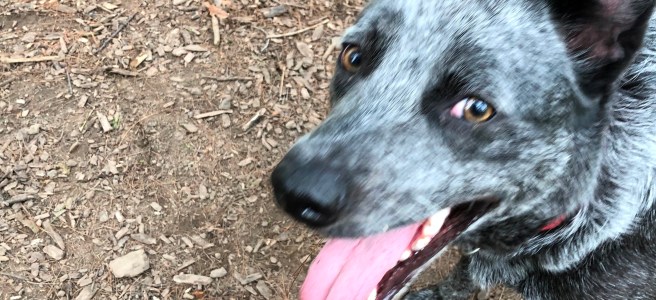
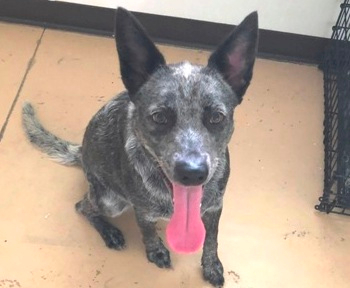
Dorito, a deaf cattle dog, was alert and attentive from the first day I met him, pictured here. He also jumped, grabbed at clothing, went bonkers if you reached for him, spun and darted and dashed when he was on leash, and was earning the reputation of being an all-around brat. But over the course of 7 sessions in 4 weeks, he learned hand signals for sit, down, touch, come, look. And he made up a variant of kick-ball fetch that showed just how smart he was – he’d retrieve the ball, bring it to the top of a slope and let it roll down to me. If he saw it wasn’t going to get right to me, he’d run to it, correct its course and go back to the top of the slope. Over time, he went from a bundle of behavior problems to a joy and was adopted by a family who knew his breed. He went home with them to become part of a trio of family dogs.
While I was still working with Dorito, I began working with Mowgli. When I met him, Mowgli presented a big challenge at his kennel door – whether you were going in or trying to leave, he scrambled to get out. As it turns out, a big dog can get themselves into narrow spaces, and Mowgli was skilled at pushing his way through.
But out in the play yard, he chilled to the point of being aloof. It was clear that people were just his ticket to get outside – hanging out with you was not on his agenda at all. He didn’t play games, he didn’t sit or come when called, and “wait” wasn’t an idea he’d ever come across. But he learned it all, including stellar manners when you’d get him or return him to his kennel. After months at the shelter, he was adopted.
Even though I didn’t work with Dorito for nearly as long as I’ve worked with other shelter dogs, they were such intense sessions – and I spent so much time researching how to work with deaf dogs – that it seems we must have met for many more times. Mowgli I did work with many more times – 29 visits over 4 months.
Working with shelter dogs like this is a time commitment, it’s an emotional commitment, and it takes up a lot of mental bandwidth. After a year and a half and over thirty dogs, with about half that number being individuals I worked with at a pretty intense level, I’ve learned an essential truth about working with shelter dogs – there will always be another dog to work with. So the dog I’ve intentionally formed a bond with exits my life, and I start on building a bond with a new dog.
The contrast between the dog that just found a home and this new dog can be pretty stark. To be honest, it can be a challenge to make the shift – I need to set my expectations back to zero and build from there based on my observations. It can be discouraging when a new dog seems a very long way from showing the kind of behaviors that will help them get adopted. I have to remind myself what a whirling dervish Dorito could be, how aloof Mowgli was when I met him, how aggressive Gils’ greeting behavior could look, how timid Karen and Buddy were. It was work to get them to a good place, and it’s going to be work to get this new dog there, too.
Sometimes when I’m starting up with a dog, I stand outside their kennel and look at them barking at me, or throwing themselves against the kennel door, or backing away as though I am one scary being, and for just a second, I think, “Seriously? From scratch, again?” And then I see this new dog as an individual. I watch them and start figuring out how we’ll start. I put my foot sideways in front of the kennel door to block it from swinging out and hitting me when I unlatch it, and head in. It is a new day, a new dog. Game on.
Wow, I haven’t posted since August. What happened? Oh right, the semester started up, I kept going to the dog shelter, I worked to get my yard in shape for winter, and I’ve been working on other writing. On the writing front, I’ve had two poems and an essay published in a pretty amazing anthology: Earth Care: An anthology of poetry and essays about Ecology.
The editor, Martin Willits Jr., took a very broad approach to “ecology.”
The titles of my piece give a sample of the breadth of the topics he was interested in: “Irish Potato Famine,” “Housing Development,” and “Redlining: An Inheritance.” There is a poem about fracking by Lee. B. Savidge, “Modern Horizontal Hydraulic Fracturing,” that gave me my first understanding of what fracking entailed; there is an essay about the successful effort to save the “forever wild” woodlands that came under threat from developers who sought to set aside the terms of a covenant agreement. Another essay, “Energy Choices,” by Linda Griggs, outlines the dangers of nuclear power and so much more. And, the volume ends with pages of resources into issues and solutions. It’s an amazing read.
Speaking of amazing, the dogs at the Potsdam Humane Shelter never fail to amaze. I’ve had a pretty long stretch of very timid puppies at the shelter since I last posted, and I mean “timid” as in, staff and volunteers were carrying them everywhere. I thought Cedric was a challenge – hah! Everyone wound up carrying these young dogs because otherwise they crawled on their bellies – when you could coax them into moving forward at all. That’s a photo of Buddy – you can see he was getting too big to be lugged around. More about them next time.
Sometimes when a family is interested in a dog, they opt to foster first rather than move right to adoption. That’s pretty common – and completely acceptable – at the Potsdam Humane Society. After all, we’re all hoping for a great match. Gils has impressed some folks, and that’s no surprise: he’s a dog with heart and smarts. So fingers crossed that he and his foster folks do just fine together and they move on to adoption!
Next up for me? I started right up with three 5 month old puppies – all somewhat shy and all leash-adverse due to their lack of experience. The more outgoing two have been adopted, but as of this morning, Buddy is still there. Read more below and check out this quick video: he’s really a smart, good-natured boy: Buddy shows off “sit”
Buddy is a big puppy – a Cane Corso mix – and ready to start his best life with a best human friend.
Like lots of other bad things, puppy mills can seem like a problem that happens somewhere else. But when a seven-year old dog whose had lots of litters arrives as the local shelter, she offers evidence that using dogs to crank out puppies isn’t some far away problem. Here’s a girl who served as a puppy factory, but now she’s out of there and ready for a good home. Meet Nellie:
Nellie is sweet-tempered and wanting to love and be loved.
At first she was so timid that sometimes it seemed she was most secure showing her friendliness when you were safely on the other side of her kennel door. (Take a peek!) But put in just a little quiet, soothing time, and she settles into feeling secure. Progress goes small steps at a time, but seeing her brief happy dances makes it worth the wait!
And those moments of joy provide evidence that she’ll adjust well to a loving home environment. Nellie might have found herself a home, but check out the other PHS dogs here: Potsdam Humane Society Adoptable dogs, or call the Shelter at 315-265-3199
Did you know? If you’re 60 or over and you’re interested in an older dog (7 and up), the adoption qualifies for the PHS “Seniors for Seniors“ program.
When you visit a shelter and the dogs start barking, you might get the impression that chaos reigns. And you might think that this environment isn’t very conducive to dog training. But you’d be wrong, at least at the Potsdam Humane Society Shelter. Here’s a video of PHS staff member Pedro H. DeSouza working with our boy Gils on the cue “down:” VIDEO of PEDRO and GILS working together in the PHS dog park.
Now that’s focus!
That nice job with consistency and follow-through on Pedro’s part pays off – Gils understands what’s being asked of him and is happy to oblige. “Yes” serves as the marker word that Gils has correctly followed the cue, “down,” and the treat is the reward. Gils also knows the cues “come,” “sit,” “touch,” and “shake.” Gils has a tough-guy look, but he’s also a smart boy who will reward the person who gives him a home and, hopefully, continues with his training.
It’s been awhile since I’ve written about the dogs at the Potsdam Humane Society. There’s been some turn over there – which is an excellent thing. Of the dogs I’ve visited with and written about, Pepper, Angel, and Lizzie have gone on to new homes. They’re nice dogs, but as it happened, I didn’t work with them very much. I visited a lot with Teddy and Gils.
Great news about Teddy – this excellent boy has found a home! His new person posts on Facebook about their wonderful new life together, and they seem a good match. Yay!
Teddy liked the tunnel, but other than that, he didn’t really take to agility. But he’s really taken to his new home.
Meanwhile, Gils is still at the shelter. He knew “sit” and “down” really well when I met him, and we’re working on “wait.” I discovered today that we have more success when I cue him to “wait” (hold his position) when he’s lying down. From now on, I’ll start our “wait” training sessions when he’s “down.” But today I got a nice photo of him holding “sit.”
Good boy, Gils!
Gils is one of those dogs whose great personality doesn’t really shine best in the kennel hallway. But get him out of the kennel hallway and you’ve got a treat-motivated, attentive dog who loves to play with soft toys (here’s a sample: Gils’ Play Drive). Hopefully someone will take the time to get to know him. He’s a good boy.