Yellowjackets and Umbrellas

European Paper Wasps

This past summer, our yard hosted Ground Yellowjackets in the front yard and Umbrella Wasps near the back door. The nest locations were a little inconvenient.
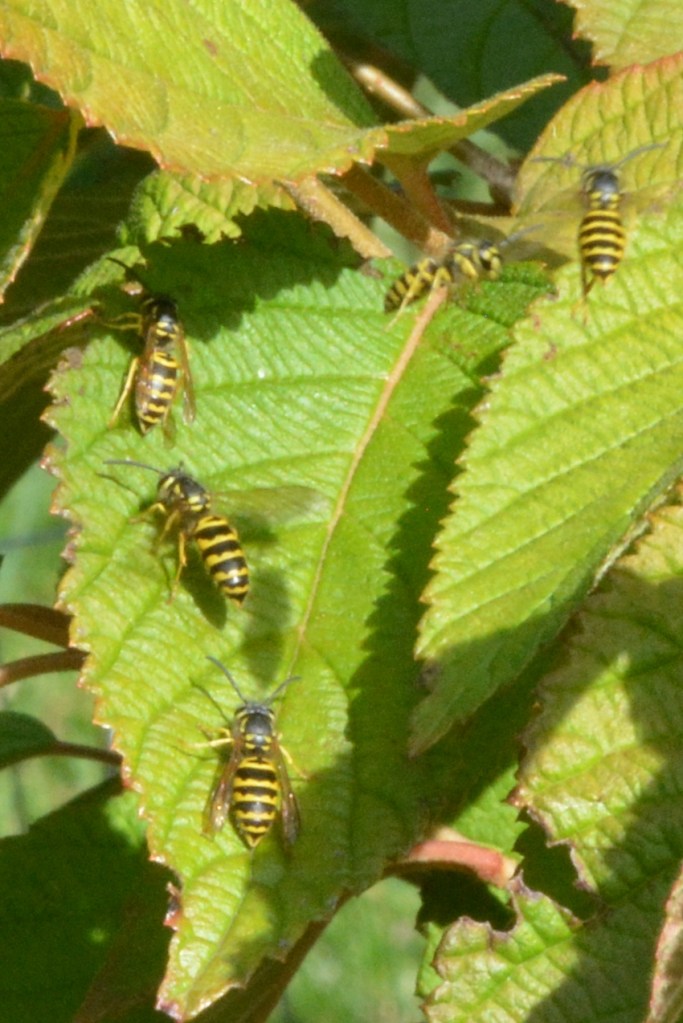
Eastern Yellowjacket and Viburnam

One mid-morning this summer I was weeding by the viburnum in the front yard and found the air filling with yellow and black insects. I backed away slowly. After a few hours, when they were visible but not agitated, I slowly and quietly returned to retrieve my garden tools and camera, and saw I’d been working inches from the Yellowjackets’ ground nest. I ceded the area to them for the rest of the summer.

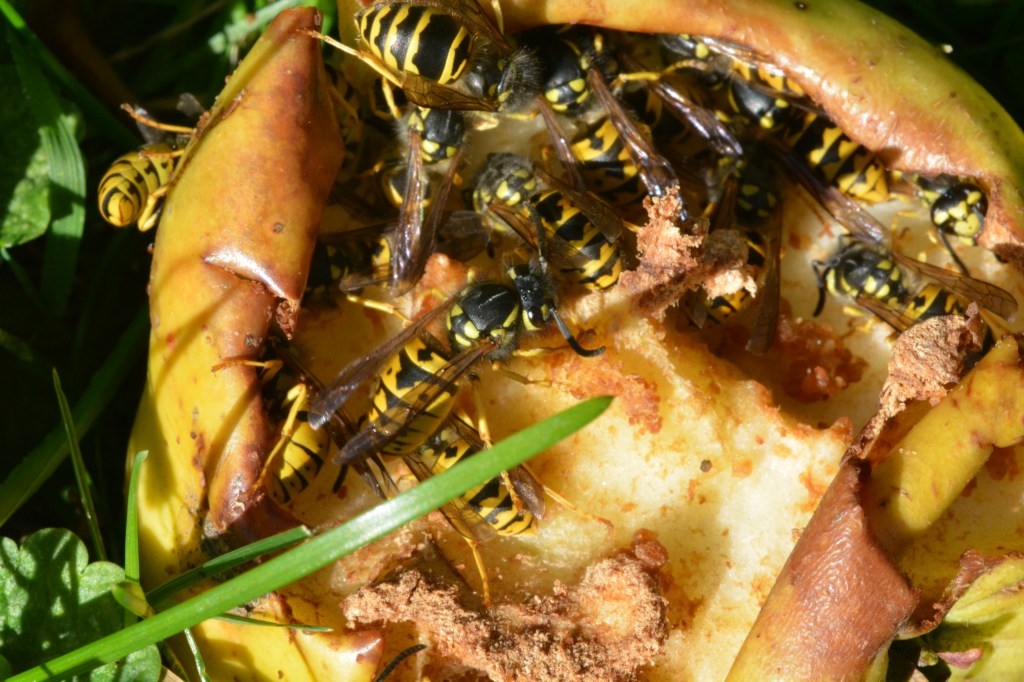
With the help of iNaturalist and Bugguide.net, I identified them as Vespula maculifrons, a Ground Yellowjacket also known as the Eastern Yellowjacket. According to Bugguide, they are the most abundant Yellowjacket species east of the Great Plains. The adults feed on nectar and the juice of ripe and rotting fruit. As it happens, I first identified this species years ago when I rented a house with a big apple tree in the backyard and couldn’t keep up with the fallen apples. Yellowjackets of several species appreciated the bounty, including Vespula germanica, the German Yellowjacket, just left of center in this photo.
Meanwhile, in the backyard, wasps nested, European Paper Wasps, Polistes dominula. Oddly enough, in a bluebird-shaped birdhouse that I’d left on the back deck.

I’ve been familiar with Paper Wasp nests under eaves, but this hidden-cavity nesting is new to me; according to information on Bugguide.net, cavity nesting in wasps is species-specific. Paper wasps in general are less territorial about their nests than Yellowjackets, and they didn’t do anything startling, but I didn’t linger on the deck once they’d taken up residence.

I waited till after a deep frost to bring the birdhouse inside to try to get a photo of the nest. It was tucked up on the right side of the “ceiling.” Note the empty cells.

The cavity nest of Polistes dominula

The members of the genus Polistes are also known as Umbrella Paper Wasps, a name I find charming without knowing why. Polistes means “founder of a city,” although since it is a fertilized female, a queen, who selects the site, builds the nest, and establishes the colony, you’ll see writers refer to the “foundress of the city.”

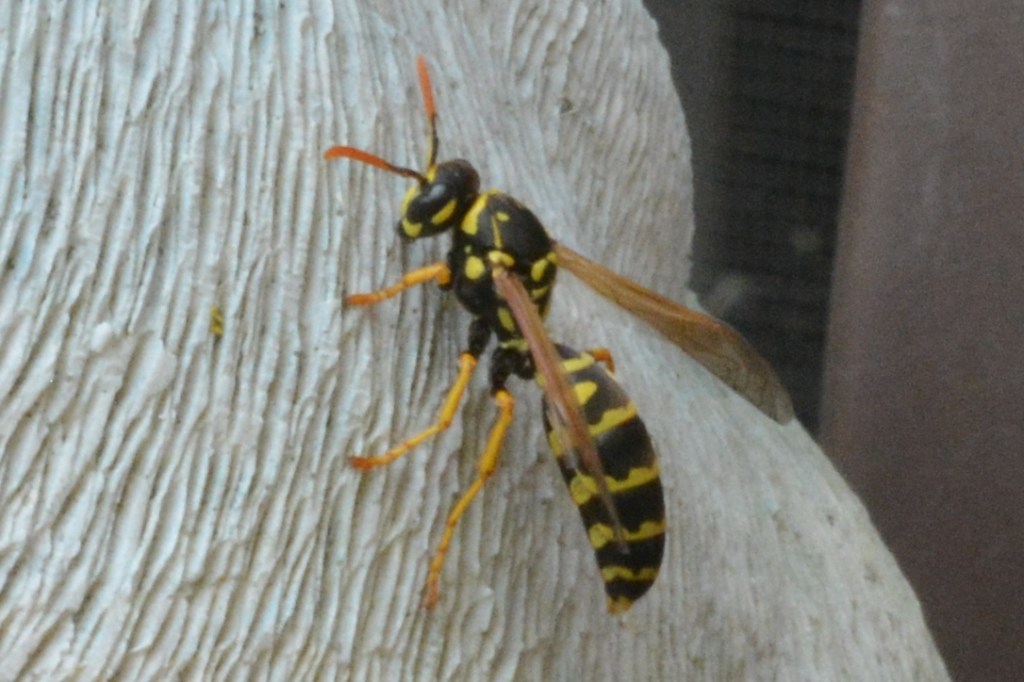
These flyers with their vibrant orange antennae, (a key identifier for Polistes dominula, by the way), were interesting company this summer – once, when I inadvertently moved the birdhouse a few inches, they couldn’t find the opening even though they flew directly over it. It took a couple of tries for me to get the birdhouse back to where they could find their way in.  When I set up my tripod to try to get better photos, I captured this behavior:

The yellow-faced male coming in for a landing.
The curly antennae are another distinguishing feature of the male.
It’s easy to see why these wasps can be mistaken for Yellowjackets.

Here in northern New York, November has been cold and, with the exception of the new queens, this year’s colonies will have died off. The new queens have left the nest and are overwintering somewhere, maybe in leaf litter, or logs, or soil. But what about next summer? It’s impossible to predict exactly where those queens will choose to start their colonies.

Even though I could, I wouldn’t do anything to discourage the Eastern Yellowjackets. I’m in the habit of leaving areas of bare ground for the ground dwelling bees, and if the wasps take advantage of them, that’s fine. I wasn’t stung or even harassed by these insects, despite them being disturbed by my pulling weeds inches from their nest entrance.  The next day when I went out to photograph them, they were already out and flying; I kept my distance and they ignored me.

But one summer of close observation of wasps on my back deck was enough: I don’t think the wasps would use the birdhouse again, but I’ll move it to the wooded area behind the house where anyone, from mice to bluebirds to wasps, will be welcome to it.

Wasp-watching is done for the year and the process of going through photos I haven’t had a chance to review is underway. And, reading and researching continues on, of course. Here are two books I’m pretty excited about, with Bookshop links:

Jill McDonald’s Exploring Insects, a book for children, is a beautiful introduction to the world of insects and critters we mistake for insects. The illustrations are attractive, McDonald uses simple language to define well-selected vocabulary, and each page offers a question that invites reflection and encourages curiosity and conversation.

Eric R. Eaton’s Wasps, The Astonishing Diversity of a Misunderstood Insect, is itself astonishing. The illustrations and photographs are worth the price of admission. I hadn’t seen this book when I ordered it through Bookshop, and I’m really struck by its quality. If you know anyone who likes wasps, you know someone who will love this book.


Picture This: Diversity in Children’s Books 2018 Infographic

Writers, editors, publishers, book buyers – there is so much work to do.

Sarah Park Dahlen's avatar박사라 Sarah Park Dahlen, Ph.D.

In 2016, we published the infographicDiversity in Children’s Books 2015.” It went viral and was discussed on Twitter, in Facebook groups, published in books and journals, and presented at countless conferences.

Today we present to you an updated infographic, “Diversity in Children’s Books 2018.

DiversityInChildrensBooks2018_f_8.5x11Link to JPG & PDF files: Diversity in Children’s Books 2018 – Dropbox Folder
Full citation: Huyck, David and Sarah Park Dahlen. (2019 June 19). Diversity in Children’s Books 2018. sarahpark.com blog. Created in consultation with Edith Campbell, Molly Beth Griffin, K. T. Horning, Debbie Reese, Ebony Elizabeth Thomas, and Madeline Tyner, with statistics compiled by the Cooperative Children’s Book Center, School of Education, University of Wisconsin-Madison: http://ccbc.education.wisc.edu/books/pcstats.asp. Retrieved from https://readingspark.wordpress.com/2019/06/19/picture-this-diversity-in-childrens-books-2018-infographic/

Released for use under a Creative Commons Attribution-ShareAlike 4.0 International (CC BY-SA 4.0 license). You are free to use this infographic in any…

View original post 316 more words

Book Review: The Awakening & Selected Stories by Kate Chopin

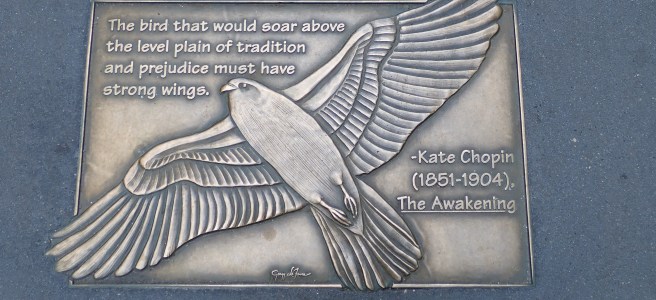
The sidewalk outside NYC’s largest public library building is embedded with plaques such as this one in honor of Kate Chopin. Stopping to read them as I walk along may make me look like a tourist, taking photographs of them definitely does. But surely their purpose is to encourage lingering and contemplation . . . and so I linger, contemplate, and take a photograph.

At home, the 1981 Modern Library version of a selection of Chopin’s work waits by our bedside, our current nighttime read-aloud. Within that volume, the strong wings of Chopin’s words guide us along the inroads of mind, heart, and body. Kate Chopin’s stories are peopled with those who act from deep motivations, and very often they pause to consider the nature and source of their emotions.

The stories are short, well-paced, and thought provoking, making this volume a wonderful read-aloud for adults – and worthy of a book club. The introduction by literary critic Nina Baym offers valuable historical context, and the glossary of terms helps fill in where context clues don’t seem to be enough.

If you pick up this volume and the first two stories lead you to believe that all will end with a lovely sweetness, keep reading. These two stories, “Love on the Bon-Dieu” and “Beyond the Bayou” will begin to teach you how to read Chopin’s stories, but they do not reveal the full arc of human potential that Chopin explores. Highly recommended.

Book Review: Two Good Dogs

Apparently, given how many books she’s written, I’ve come late to the game of reading Susan Wilson’s work. Yesterday, I was browsing library shelves, wondering how I was going to find a comparable title for my own novel, when I saw the word “dog” and pulled Two Good Dogs from the shelf. I skimmed the back cover and the beginning of the front flap copy and plucked The Dog Who Danced from the shelf as well.

At home I settled in with the more recent book first. A few pages into 2GD, I wasn’t optimistic. The writing itself was more than adequate, but the pace at which plot lines came at me was daunting. I don’t need a slow-poke start, but I was too clearly reminded of novels that rocket along in this way all the way to the end, throwing characters and complications in right up to the last chapter. I was looking for a book to relax with, not keep up with. I was very glad, then, when the story line settled down. The world-building had done the job, and I could relax as the story unfolded.

There are complications of modern life to be had here: teenage addiction, dog-fighting and dog rescue, parent-child wrangling, economic woes. So this isn’t a sappy book. But there is the reassuring sense that things will turn out all right: a big dose of realism meets an equally big dose of good fortune. Is that escapism? Probably, but in a world that is going, as my grandmother might have said, “To hell in a hand basket,” I, for one, can use the break. I’m 14 chapters into the book, and I’m glad to keep going.

Recommended.

Book Review: Scary Stories to Tell in the Dark

I’m working on a ghost story and, by way of procrastination as much as by way of research, I settled in with two slim volumes of ghost stories: Scary Stories to Tell in the Dark, and More Scary Stories, by Alvin Schwartz. In their pages, I was amused to find a few traditional ghost stories that I myself had heard and passed on. Two of them I heard from my uncle, Gerald Shattuck. He was a very good story teller. The first story he told was a “Cemetery at Night” story.  We were amused, but not scared much. But then, in a low, serious voice, he told the tale of his own experience with the “Ghostly Hitchhiker,”

One night, my friend and I were driving along on a dark road. Suddenly, in our headlights we saw a distraught young woman by the side of the road. She flagged us down. Of course, we stopped. We wondered if she were hurt, but she insisted that she just needed a ride home. She gave us an address and we started off. From the back seat she told us how grateful she was. We were very worried about her, and when we asked her a question and she didn’t answer, I turned to the back to check on her – she was gone! She had disappeared! We stopped at the first little store we came to and reported what we had seen. The people there had heard this story before. We discovered that a young woman had been killed by a hit-and-run driver at the very spot we first saw her. Her spirit has haunted the roadside ever since, looking for the guilty person who killed her.

Told this way, it is a compelling story: we young listeners were suitably caught between belief and disbelieve. I, myself, passed on the story when I told it to a carload of middle-schoolers I was driving to an activity night. To my great surprise, the most credulous among them fell for it hook, line, and sinker, and I spent some time back peddling and explaining the nature of ghost stories.

When they were first published, the series was very popular with children, but deemed too gross and scary by some adults. The stories are based on folktales – old and modern – and they are scary, especially the illustrations. And if you find ghosts eating the pus of their rotting stomachs gross, (which I do!) they are gross. All in all, I agree with Harper’s 1984 review of another Schwartz publication, “a nicely nasty collection.” I’ll be on the lookout for more volumes.

If I find any, I’ll be looking for more than ghost stories. In the Acknowledgments section of the two volumes, an interesting tale is hinted at – that of a marriage and of the changing public roles of women. In the first  volume, published in 1981, the author acknowledges his wife with these words, “My wife, Barbara, who did the musical notation . . .  carried out bibliographical research, and contributed in other ways.” By 1984, he identifies her in this manner, “. . . my wife and colleague, Barbara Carmer Schwartz.” How she came to be acknowledged with her full name and a more professional status is a story I’d like to hear.

Book Review: Paris by the Book

Promising title, nice cover, but . . .

I’ve just returned Liam Callanan’s Paris by the Book to the library. The book has a fun cover and a promising title, but the execution fell short. While I came to really like the two daughters, Callanan used coincidence and inexplicable infusions of cash to fuel the plot. He also dipped a toe into “issues” without ever setting the groundwork for them or developing their meaning within the story. For instance, the plot touches on the treatment of black immigrants in Paris and the disagreement in the US about the wisdom of vaccinating children – and moves on with no further mention. In the afterword the author confirms there is no such thing as the magical visa that allows the Americans to stay in Paris, but there was at least one other, even more far-fetched, plot device to explain away. The good writing kept me reading, but the contrived and muddled plot had me shaking my head.

What I’ve Been Reading

I’ve sometimes been guilty of explaining why I’m not currently reading a book by joining the club that claims, “too busy,” or “too tired at the end of the day.” I like my life better when I’m explaining, instead, why I read so much. When I was  kid, I was a ‘bookworm’ and nothing more needed to be said about why I chose the company of books over people, why I carried a book with me when I climbed the tree in the back yard, or why I stayed up late reading a book by flashlight after bedtime.

When I taught 8th graders, I had an excuse for gobbling down several MG and YA books a week – I needed to read widely so I had many books to choose from when a student needed a recommendation. I always told my students who said they didn’t like to read that they just hadn’t met the right book yet, and then I’d stack a bunch up – pulling them from my extensive classroom collection of paperbacks – and give them the advice to read the first page or so, and when they wanted to keep going, they’d found their book.

But my teaching focus now is writing, and even though I believe reading and writing can’t be divorced from each other, they have drifted apart in my professional life and, by no coincidence, I suppose, in my personal life. So, to bring reading back into focus for me, I’ll share here thoughts on the books I’m reading now.

Open House by Patricia J. Williams

Unfailingly sharp witted and generous, Williams combines her close observations of life, injustice, joy, and expensive take-out with her ability to pull back, always, to the big picture and to ways of making meaning that we can move forward with. Her story-telling carries, for me, faint undertones of the potential for a lecture, but the best kind of lecture – one in which you are given new information by being given new ways to think about things, with never once being crowded into a box of the author’s own making. Never preachy, always on point, this slim volume, subtitled, “Of Family, Friends, Food, Piano Lessons, and the Search for a Room of My Own” is a treat.

Book Review: Not Exactly Love

Not Exactly Love: A MemoirNot Exactly Love: A Memoir by Betty Hafner
I met Betty Hafner, author of Not Exactly Love: A Memoir, at a get-together for writers in Saranac Lake last year. It took me awhile to act on my good intentions to buy her book, and then to read it. It is an impressive book – for all the reasons other reviewers mentioned. Very skillful narration and selection of details, and evocative of a time (not entirely ended) when the pressure to be paired up was palpable and the momentum towards the altar pushed young people along and into disastrous commitments. Bravo!

Winter Deserves Its Own Reading List: A Book Review

It’s odd that summer is the only season to inspire reading lists. Doesn’t winter lend itself just as well, if not better, to a cozy read? Long nights and snow-covered gardens ought to be at least as conducive to losing yourself in a book as long days and inviting weather. And, if summer is for light – even guilty – reading, might not winter lend itself to reading of more heft, more words that will stay with you long after you set the book down?

Gardeners know one sort of winter reading, of course – seed catalogs. They find their way to our mail boxes right about now and parade the lush possibilities of spring and summer. With their bright colors and perfect blooms, they provide a temporary escape from winter, a dreamy state of what might be – a sharp contrast to the no-nonsense realities of long nights, winds whipping with snow, and nose-hair freezing temperatures.

But I don’t want always to escape from winter – where is a book that indulges my love of the stark, uncompromising season in which I will never need to mow the grass or pull a weed? A book that celebrates our long winter season here in Northern New York, that makes our heart glad to look out the window to the riches of life when we might otherwise have seen just a barren blanket of snow?

I discovered just such a book in a drugstore rack of works by local writers: Adirondack Nature Notes. Written by Tom Kalinowski and illustrated by Sheri Amsel, this is a book to keep us company in the winter and beyond: it begins with January and moves through the year from there. What can there be to say about January? Moose, muskrat, shews and moles; the Gray Jay and the Snowy Owl; oxygen levels, tracks, and life beneath the snow and under the ice.

Tom is skilled at anticipating what the reader might be wondering about and presenting information in a logical, understandable way. For example, I was wondering about the occasional dead vole I’ve found on top of the snow. Did it go up there to die? Why hadn’t some wild creature eaten it?  And I was wondering too, why my dog had no more than passing interest: it seemed like something he would pounce on and gulp down before I could stop him. This book has the answer: turns out that the little creature was caught, and then, when the predator identified what it had caught, it was rejected. Why? Because moles and voles have a horrible taste. So, as Tom points out, that little brown corpse on the snow tells me two things – there is a predator around and food is plentiful enough that it didn’t need to eat this unsavory meal. And that bad taste explains why no other creature, including my dog, made a meal of it. Of course, I knew there were predators around – but now I’ll look more carefully for signs of that particular predator when I see this sort of evidence.

I love to fall in love with a book, to find one I know I will read and come back to again and again. Thank you Tom, Sheri, and North Country Books for Adirondack Nature Notes – it’s the first book on my 2017 Winter Reading List.